Plugs
HSP1P plugs (PLG) mate only with HSP1P wall or coupler sockets in zones 1, 2, 21 and 22. PA66 housing, IP66. Currents 16 / 32 / 63 / 125 A. Certificate TÜV CY 25 ATEX 0207475 X. A matching pair needs the same current, voltage, poles and PE. Check ambient temperature and cable OD on the SKU page.
Filter by: current · voltage · poles · PE · AUX/OC (125 A only) · cable OD. Pair = same parameters except socket type code D (W-SCT or C-SCT).
Selection guide · W-SCT wall · C-SCT couplers · All HSP1P
PLG data & FAQ
| Code D | PLG · optional PLG OC (125 A) |
|---|---|
| Currents | 16 / 32 / 63 / 125 A |
| Material | PA66 |
| IP / zones | IP66 · 1, 2, 21, 22 |
| PE | IEC 60309 clock; 2P = n/a |
| OC (AUX NO) | 125 A only |
- SKU:
HSP1P … PLGor… PLG OC(NO contact at 125 A). - At 16/32 A, rotating the plug operates the switch in the socket; at 63/125 A, use the knob on the socket cover.
| Voltage | 3P | 4P / 5P |
|---|---|---|
| 20–25 V AC | h12 | — |
| 20–25 V DC | h10 | — |
| 36–50 V AC | h12 | — |
| 36–50 V DC | h10 | — |
| 50–250 V DC | h3 | — |
| 110–130 V AC | h4 | — |
| 200–250 V AC | h6 | h9 |
| 380–415 V AC | h9 | h6 |
| 480–500 V AC | h7 | h7 |
| 600–690 V AC | — | h5 |
2P: no PE contact. A plug only fits a socket with the same PE hour.
Can an HSP1P plug mate with another Ex socket series?
No. An HSP1P plug must be used only with an HSP1P socket (mechanical interlock and coding). Do not mix series.
What does the housing colour mean?
Colour follows the IEC voltage code and helps identify the version. Still verify current, poles and PE in the ordering code.
When should I choose PLG OC?
The OC suffix is an optional normally-open auxiliary contact. Catalogue range only at 125 A.
Which socket does a PLG plug mate with?
An HSP1P W-SCT wall socket or C-SCT coupler socket with the same current, voltage, poles and PE position. Only the type suffix differs (PLG → W-SCT / C-SCT). For 125 A with OC: PLG OC with W-SCT OC.
What does the PE position (h6, h9…) mean?
Position of the protective earth contact on a clock face (IEC 60309), viewed from the socket front. It depends on voltage and poles, e.g. 380–415 V 4P/5P = h6, 200–250 V 4P/5P = h9. A plug only fits a socket with the same PE hour. Full table in the selection guide.
4P or 5P — what if only 4 cores come out of the wall?
4P = 3 phases + PE (no N), 5P = 3 phases + N + PE. A three-phase load without N (e.g. a motor) uses 4P. A 5P socket needs separate N and PE; the PEN conductor is split in the distribution board, not in the socket. TN-C is not permitted in Ex areas (IEC 60079-14).
Motor runs the wrong way — what to change?
Swap any two phases (e.g. L1 and L2) with the supply isolated, in the feeder or at the load. Done by an electrician; open Ex enclosures only per the HSP1P instruction.
Sources: TÜV CY 25 ATEX 0207475 X · HSP1P instruction · HARDO plug pages. Updated: 2026-11-19.
Showing 13–24 of 54 results
-
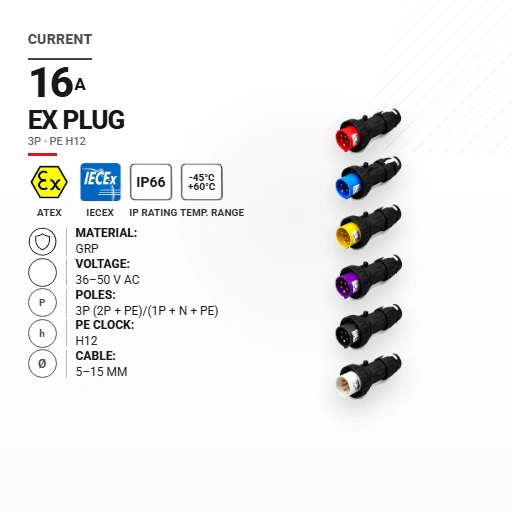
Plug 16 A | 36–50 V AC | 3P | PE h12
66,51 € -

Plug 16 A | 480–500 V AC | 4P | PE h7
60,73 € -

Plug 16 A | 480–500 V AC | 5P | PE h7
67,65 € -
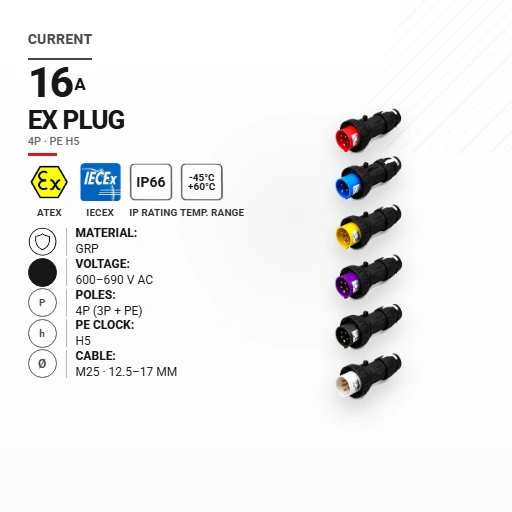
Plug 16 A | 600–690 V AC | 4P | PE h5
60,73 € -

Plug 16 A | 600–690 V AC | 5P | PE h5
67,65 € -
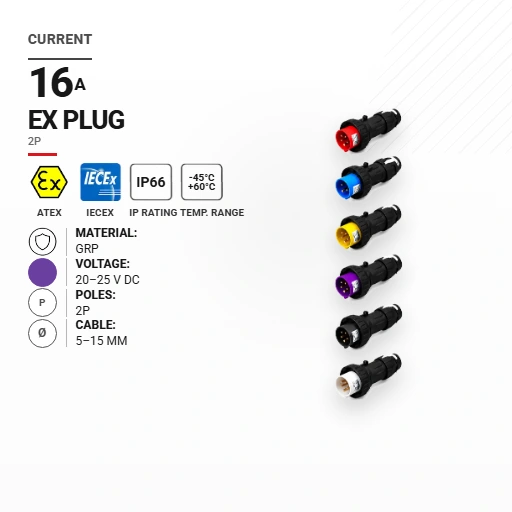
Plug 16 A | 20–25 V DC | 2P
66,51 € -

Plug 16 A | 20–25 V DC | 3P | PE h10
66,51 € -
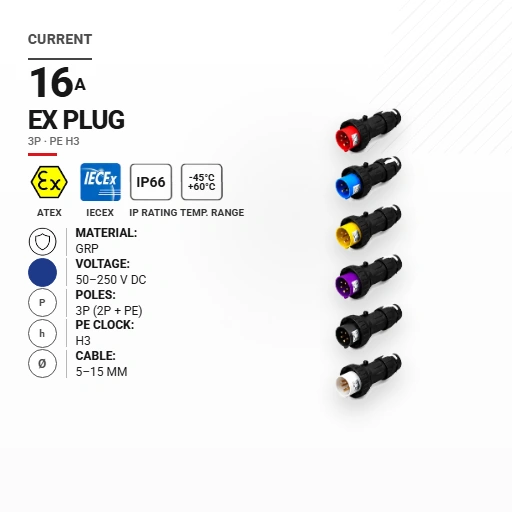
Plug 16 A | 50–250 V DC | 3P | PE h3
44,99 € -
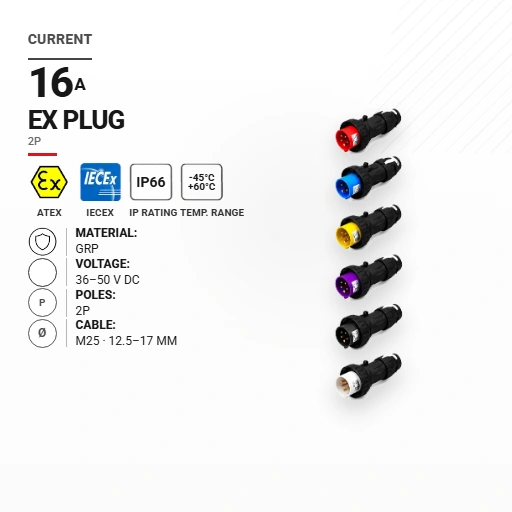
Plug 16 A | 36–50 V DC | 2P
66,51 € -
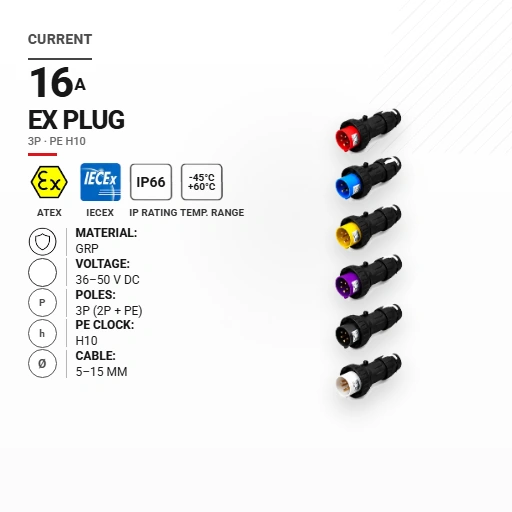
Plug 16 A | 36–50 V DC | 3P | PE h10
66,51 € -
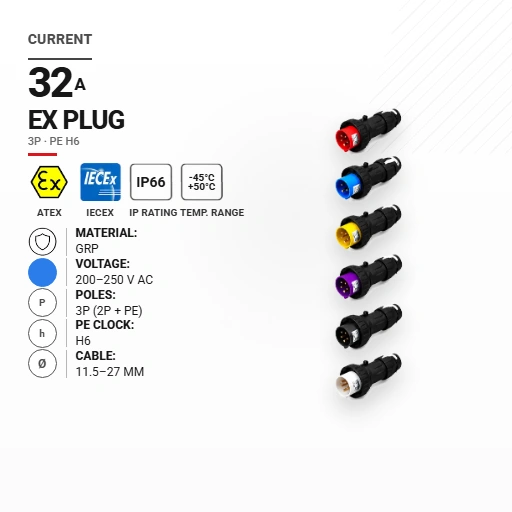
Plug 32 A | 200–250 V AC | 3P | PE h6
169,29 € -

Plug 32 A | 200–250 V AC | 4P | PE h9
90,29 €
How to use socket & plug filters
The panel narrows the HSP1P series (W-SCT / C-SCT / PLG). A matching socket–plug pair needs the same current, voltage, poles and PE clock. Family certificate: TÜV CY 25 ATEX 0207475 X · IP66.
1Device type
Wall (W-SCT) · coupler (C-SCT) · plug (PLG). On a child category, type is sibling navigation.
2Current & voltage
16 / 32 / 63 / 125 A. C-SCT only 16/32. Voltage shows the IEC colour disc — colour does not replace the code.
3Poles & PE
2P–5P. PE clock from the IEC 60309 catalogue — 2P = n/a. Do not use the Excel PE column.
4AUX / cable OD
AUX (OC) only at 125 A (W-SCT / PLG). Cable OD filters via product meta; ranges differ per SKU.
Example: 32 A + 380–415 V + 5P → three products (wall, coupler, plug) with the same specification except type code D.
Coupler-only hides 63/125 A. 63/125-only hides Coupler on the parent. AUX appears only when 125 A is selected. 16/32 A: rotate plug; 63/125 A: rotary knob on the socket cover.
Open the HSP1P selection hub — BLUF, comparison tables, procedure and engineer FAQ (GEO-strict).